_-_2021-09-09_-_13.jpg)
Valid
The displayed certificate is the current issued registry record.
 Verified HikesRegistry
Enter the certificate ID, paste its official link, or scan its QR code.
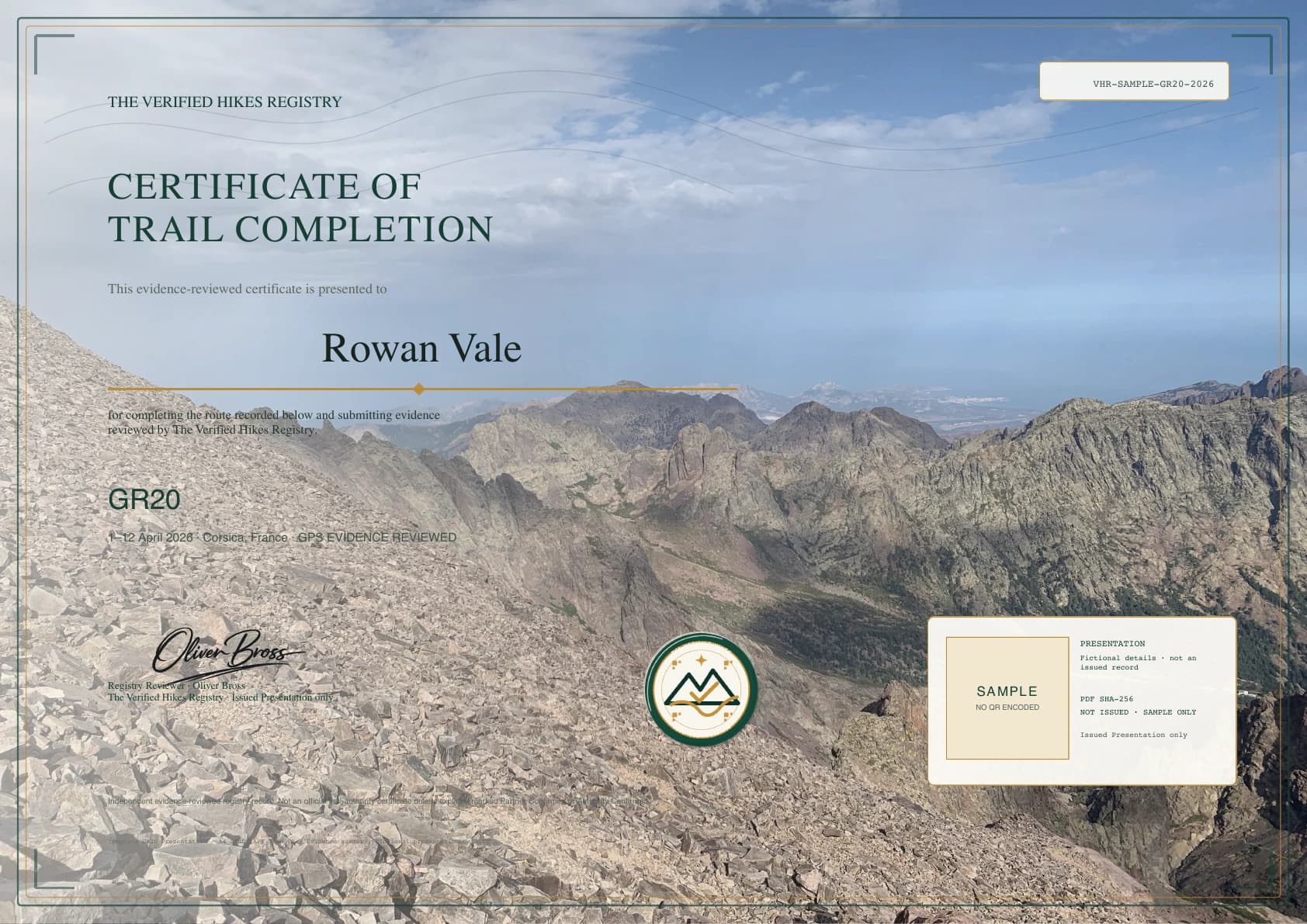
The same registry identity appears as text, inside the QR destination, and on the public verification record.
A real issued ID follows the VHR-TRAILCODE-YEAR-SHORTID format.
Scan it to read the official destination. The scanner never opens an external link automatically.
Genuine public records use https://verifiedhikes.com/v/[certificate ID].
A registry record connects the printed certificate to its current status and privacy-safe public metadata.
Open the demo verificationRaw GPS files, photographs, permits, and reviewer notes are not shown.
The public record tells you whether the document is current. Privacy choices can also limit the recipient name shown without publishing private evidence.
The displayed certificate is the current issued registry record.
A replacement certificate was issued for this record.
This certificate has been replaced and is no longer the current version.
Verified Hikes has withdrawn the certificate's active registry status.
No public registry record matches the submitted identifier.
A public record is deliberately specific about what Verified Hikes can confirm.
A verification level describes what was reviewed or confirmed. It does not imply trail-authority endorsement unless the public record explicitly says Authority Confirmed.
The record shares enough to verify a certificate without exposing the material used to review it.
Raw GPS and activity files, exact coordinates, original photographs and metadata, permits, contact and payment details, reviewer notes, and support correspondence.
The chosen name display, trail, completion date, verification level, evidence summary, status, issuer, signature state, PDF fingerprint, and certificate ID.
The registry records both the issued PDF's exact fingerprint and a signature over certificate-critical metadata.
A SHA-256 fingerprint identifies the exact issued file bytes. Editing or re-exporting the PDF changes that fingerprint.
Compare the full SHA-256 value shown on a real public record with a locally calculated file hash.Certificate ID, status, snapshot hash, PDF hash, issue time, issuer ID, and signing key ID are signed with Ed25519.
A valid signature confirms consistency with the registry signing key. It does not expand the claims made by the record.VHR-TRAILCODE-YEAR-SHORTID
https://verifiedhikes.com/v/[certificate ID]
Schema verified-hikes.certificate.v1 uses Ed25519. The public record exposes the signature state, metadata hash, PDF SHA-256, and signing key ID without exposing private signing material.
A matching SHA-256 value confirms identical PDF bytes. It does not independently prove legal identity or claims beyond the registry record.
Genuine public records use HTTPS, the exact verifiedhikes.com hostname, and the /v/ certificate route.
https://verifiedhikes.com/v/VHR-EBC-2026-8K42P9Lookalike domains, unexpected ports, embedded usernames, and unrelated paths are rejected.Report an unknown ID, unexpected domain, changed certificate detail, fingerprint mismatch, privacy concern, or misleading claim privately.
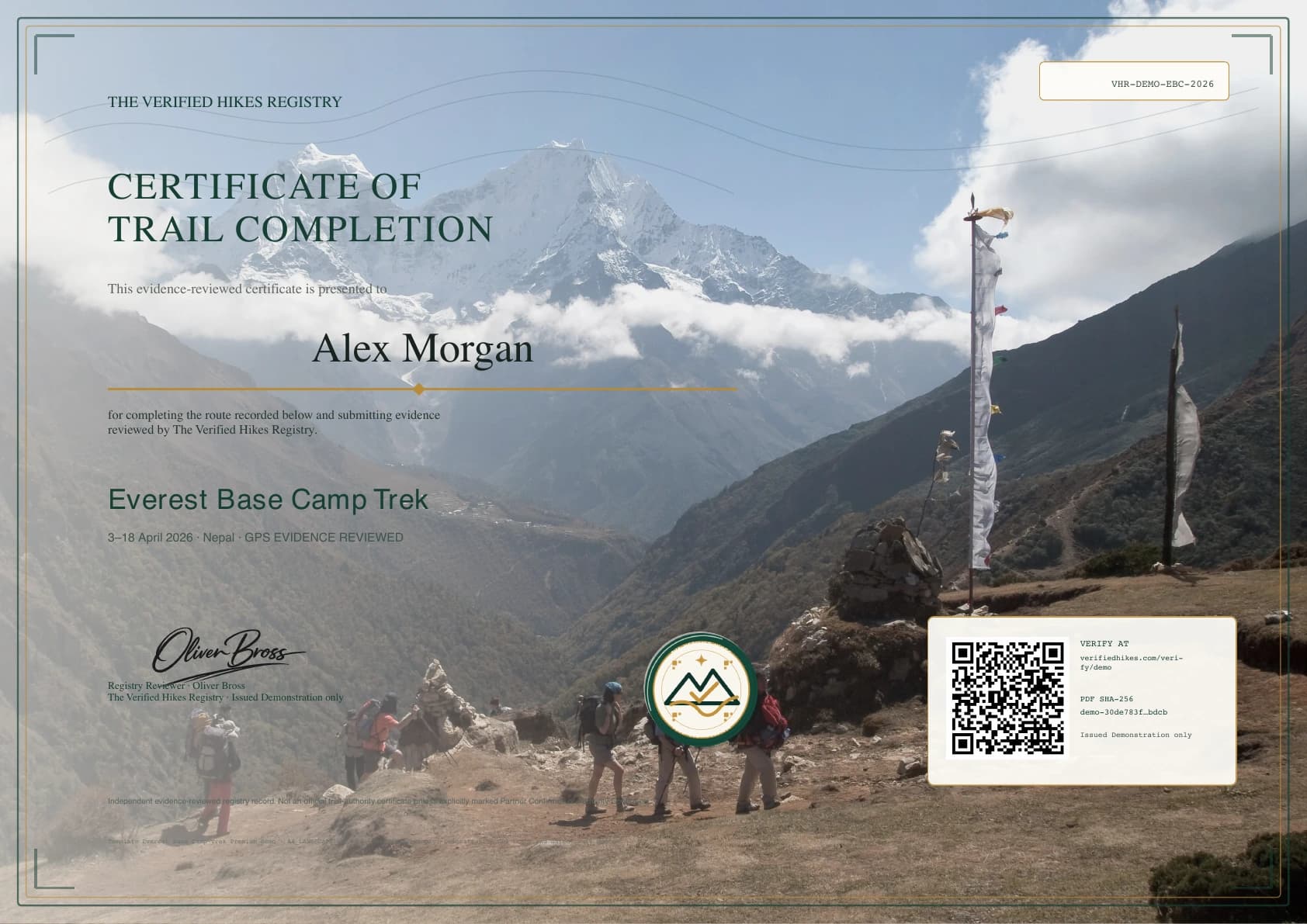
Open the fictional certificate to see status, verification level, privacy, and document integrity together.